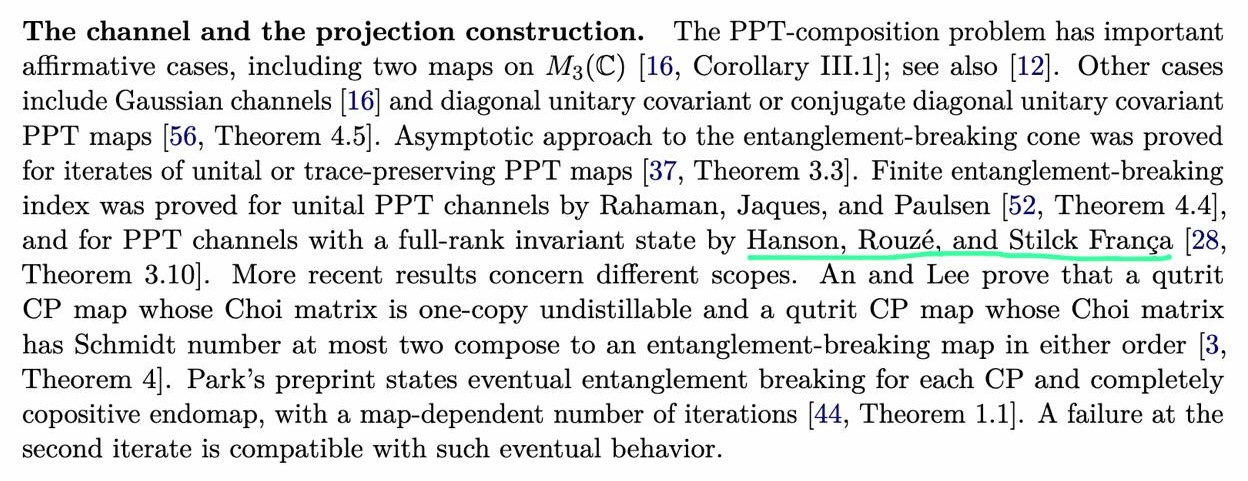
The conjecture was a conjecture in quantum information theory which was recently disproven by OpenAI in a preprint they made public on October 6, 2026. I worked on the conjecture a little bit in my PhD, and I was excited to see they cited my coauthors and me as prior work:
There are a few ways to formulate the conjecture, but the one that made the most sense to me is roughly as follows. In quantum information theory, you can have “entangled” states that have a special kind of non-local correlation (the special quantum sauce you don’t get classically). Noise can easily disrupt entanglement, and we model that noise as a “map” that takes states to statesStates are just the possible configurations of a system. A very noisy map will always break entanglement, meaning that no matter how entangled a state is, after applying the map, it has no entanglement left — these are the entanglement breaking maps. Some maps have a mathematical property called positive partial transposewon’t get into it, or PPT, and it was thought they are “almost” entanglement breaking, in the sense that if you apply it once it may not break entanglement, but if you apply it twice, it always will. That was the conjecture: when you compose a PPT map with itself (thus “squaring” it), the resulting map is entanglement breaking.
OpenAI found a map (on states of a 21-dimensional system) for which this is not true! Well, supposedly found, the preprint has not been peer reviewed, but I expect it will hold up (potentially after minor corrections).
I was a bit surprised by this new development, though perhaps I should not have been. There was never a very strong reason to believe the conjecture should be true, and it seemed somewhat extreme. However, a lot of researchers had tried to disprove it, and it was proven true in many special cases, so it felt like maybe it just is true thanks to some unknown algebraic miracle. Nope! It seems we now have the technology to find such counterexamples, and we perhaps did not beforeor were we just insufficiently persistent?.
My coauthors and I back in 2019in 1902.08173, which I also discuss in this blog post showed that under another technical assumptionfaithfulness, PPT maps are always “eventually” entanglement breaking, in that if they are applied times (for some finite that depends on the map), they always break entanglement. The conjecture would have been that always works. While OpenAI’s paper kindly cited our prior work, they did not build on it at all; the tools we used and developed were not well suited for the task. They did build on other prior work in the field.
The conjecture remains open: maybe any PPT map is such that is entanglement breaking. The map OpenAI found is apparently entanglement-breaking when cubedaccording to Claude Opus 5.5, who did some numerics for me. I have not checked it myself., so it does not provide a counterexample to the conjecture.